
History of the Euro Oval Car Sticker:
These white oval bumper stickers have a really interesting history.
How did they get so popular? Where did they originate? (You guessed it ... Europe, but why?) Read on to get a front seat into the evolution of the oval bumper sticker.
From Practical Origins to a Cultural Phenomenon: The Voyage of the Euro Oval Car Sticker
The humble Euro Oval Car Sticker, with its familiar oval shape and bold country codes, may seem like a simple roadside accessory. But its history is surprisingly rich, tracing back to international agreements and evolving into a symbol of both practical needs and cultural pride.
Born from a Need for Standardization:
Following the chaos of World War II, Europe's roads buzzed with vehicles from various countries. License plates, often similar in size and color, made identifying origins a challenge. Enter the United Nations Geneva Convention on Road Traffic (Wikipedia) of 1949. This landmark agreement laid the groundwork for a standardized vehicle identification system, including the iconic oval stickers we see on cars today.
Formalized by the Vienna Convention:
The concept of the Euro Oval Car Sticker was further formalized during the 1960s with the Vienna Convention on Road Traffic (Wikipedia). This convention aimed to further standardize vehicle registration plates and introduced the idea of a country code within a clean, easy-to-read oval. The stickers were to display a two to four-letter country code, conforming to the International Vehicle Registration Code. The idea was to make it easier for people to identify the country of origin of a vehicle.
From Mandatory to Voluntary:
While initially proposed as a mandatory part of the standardized system, the Euro Oval Sticker's adoption became voluntary over time. Yet, its practicality as a visual cue for drivers and pedestrians ensured its continued use. It offers a quick reference to a vehicle's origin, promoting safety and awareness on the road.
Beyond Utility: A Cultural Phenomenon:
But the Euro Oval Car Sticker's story doesn't end there. Over time, it transcended its utilitarian origins and blossomed into a cultural phenomenon. Whether proudly displaying the "GB" of the United Kingdom or any other nation's code, these stickers became a way for drivers to express their heritage and connection to their roots.
A Souvenirs across Borders:
The oval's global recognition extends beyond national borders. Tourists often purchase these stickers as souvenirs during their travels, keeping a tangible reminder of their adventures. It's a subtle yet widely recognized symbol on roads worldwide, a silent conversation starter about one's connection to different places.
A Legacy of the Geneva Convention:
The Euro Oval Car Sticker's evolution is deeply intertwined with the collaborative efforts of the Geneva Convention. The convention's provisions for standardized vehicle registration and the International Vehicle Registration Code not only created a practical identification system but also laid the foundation for a symbol that reflects both individual identity and global unity.
The Final Sticker:
So, the next time you see an unassuming oval sticker on a car, remember its rich history. It's a testament to international cooperation, a symbol of personal pride, and a small but significant piece of cultural expression that continues to roll through the world, one nation at a time.
Further Exploration:
Bonus Fun Facts:
- The original oval sticker specifications were precise: 9 inches tall by 6 inches wide, with black capital letters on a white background.
- The United States never officially adopted the mandatory oval, but its popularity as a decorative sticker soared in the 1980s.
- The "OBX" sticker, representing North Carolina's Outer Banks, is one of the most popular non-country oval designs in the US.
Here is an excerpt of official text below from the UN's Vienna Convention on Road Traffic in 1969:
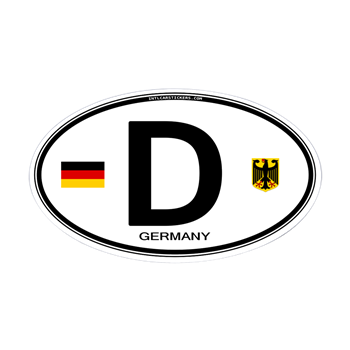 Germany oval car stickerANNEX 4. DISTINGUISHING SIGN OF VEHICLES IN INTERNATIONAL TRAFFIC
1. The distinguishing sign shall be composed of one to three letters in capital Latin characters. The letters shall have a minimum height of 80 mm. (3.1 in.) and their strokes a width of 10 mm. (0.4 in.). The letters shall be painted in black on a white ground of elliptical form with the major axis horizontal.
2. If the distinguishing sign is composed of three letters, the dimensions of the ellipse shall be at least 240 mm. (9.4 in.) in width and 145 mm. (5.7 in.) in height. The dimensions may be reduced to 175 mm. (6.9 in.) in width and 115 mm. (4.5 in.) in height if the sign carries less than three letters.
As regards the distinguishing signs for motorcycles, the dimensions of the ellipse, whether the sign is composed of one, two or three letters, may be reduced to 175 mm. (6.9 in.) in width and 115 mm. (4.5 in.) in height.
3. The distinctive letters for the different States and territories are as follows:
... See here for full list of country codes ...
Any State which has not already done so shall on signature or ratification of, or accession to, this Convention, notify the Secretary-General of the distinctive letters selected by that State.
4. When the distinguishing sign is carried on a special plate this plate shall be fixed in a vertical or nearly vertical position and in a plane perpendicular to the longitudinal axis of the vehicle itself. When the sign is fixed to or painted on the vehicle itself, this shall be done on a vertical or nearly vertical surface at the back of the vehicle.
Order an oval sticker from Intlcarstickers.com!